With the rapid development of high-speed optical communications, lasers, and photodetectors, indium phosphide (InP), an important III-V compound semiconductor material, plays a vital role in the manufacturing of optoelectronic devices.
The production of high-quality InP single crystals depends not only on advanced crystal growth equipment and precise process control but also on the use of critical consumable components. Among these, pyrolytic boron nitride (PBN) crucibles have become an important choice for compound semiconductor crystal growth due to their high purity, chemical stability, and unique thermal properties.
So, why are PBN crucibles well-suited for InP crystal growth? And what key technical requirements should be considered when using different crystal growth methods, such as Vertical Gradient Freeze (VGF) and Liquid Encapsulated Czochralski (LEC)?
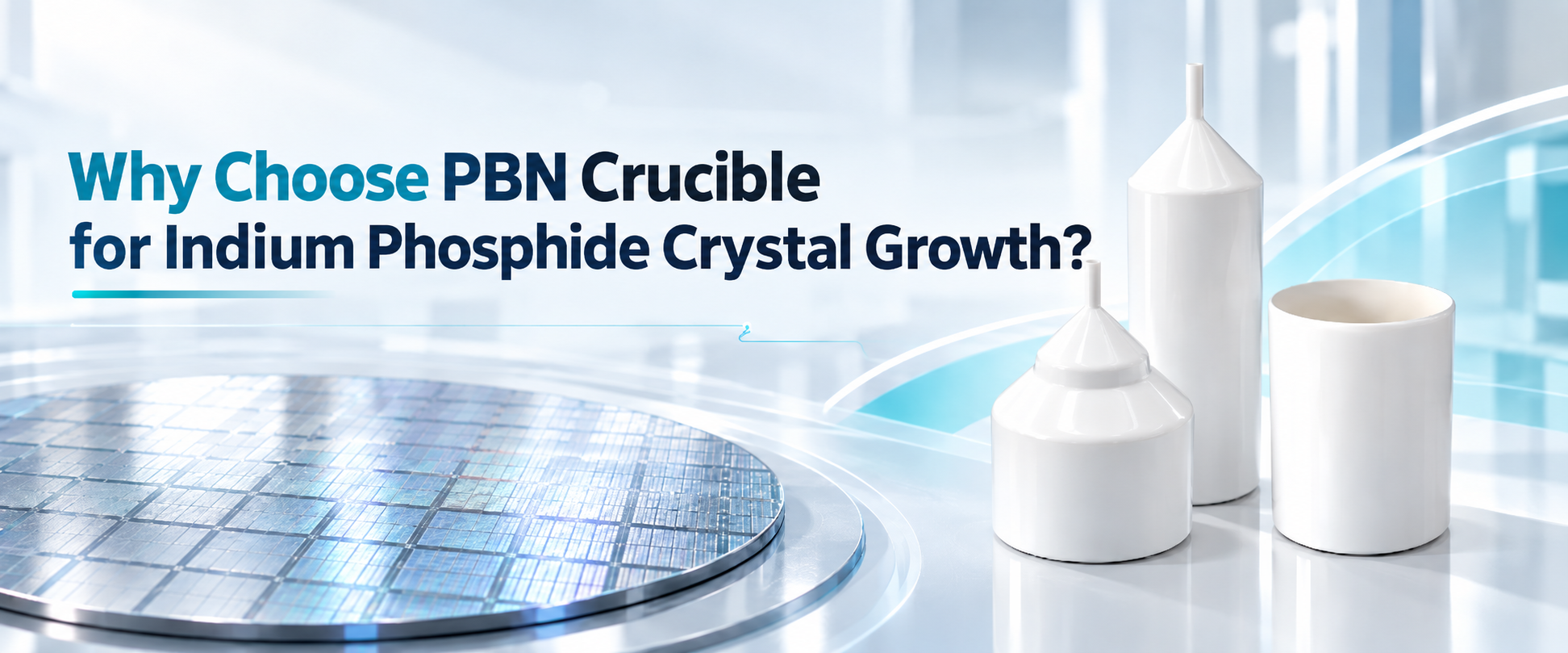
Indium phosphide (InP) is widely used in high-speed optical communications, lasers, photodetectors, and photonic integrated circuits (PICs) due to its unique properties, including a direct bandgap and high electron mobility.
During InP single crystal growth, the raw materials undergo several stages, including melting, crystal growth, and cooling. Factors such as temperature distribution, melt conditions, impurity control, and the processing environment can all influence the quality of the final crystal.
As a critical component that holds the molten material, a crucible serves more than just a containment function.
On one hand, the crucible must withstand the required high-temperature and chemical environments while minimizing the risk of contamination or adverse interactions between the crucible material and the melt. On the other hand, its shape, wall thickness, and structural design can also affect its compatibility with the thermal environment of the crystal growth equipment.
Therefore, crucible material selection and structural design are essential considerations in the InP crystal growth process.
This is also one of the key reasons why PBN crucibles have attracted significant attention in compound semiconductor crystal growth applications.
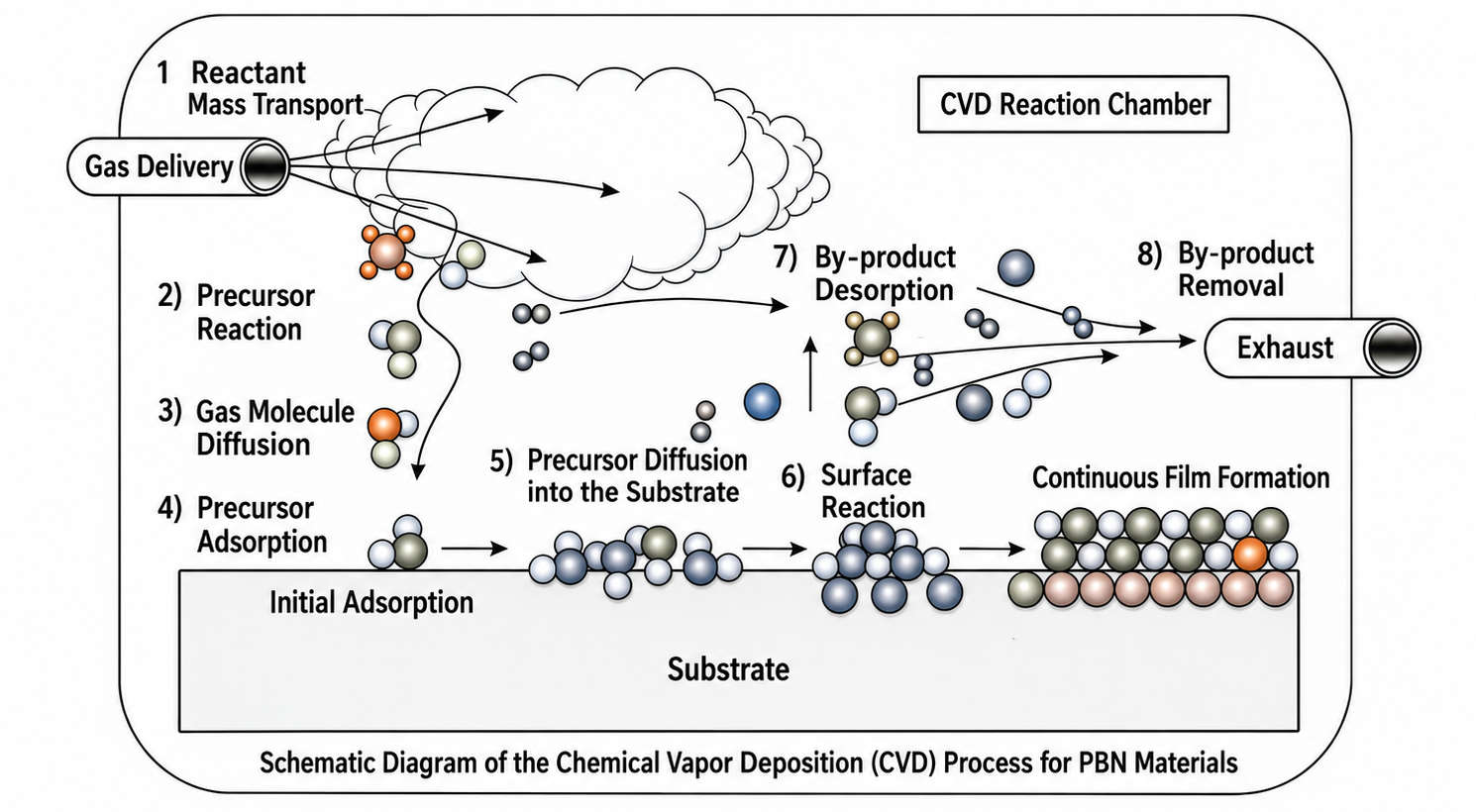
PBN, or Pyrolytic Boron Nitride, is a high-purity ceramic material produced through the Chemical Vapor Deposition (CVD) process.
Unlike certain boron nitride ceramics manufactured using conventional sintering methods, PBN is formed through vapor-phase chemical reactions that deposit material onto a substrate surface. This manufacturing process gives PBN distinctive characteristics, including high purity, a layered microstructure, and anisotropic thermal conductivity.
These material properties make PBN well-suited to meeting the demanding requirements of crucible materials used in compound semiconductor crystal growth.
Material purity is a critical consideration in compound semiconductor crystal growth.
During crystal growth, raw materials, the processing environment, and consumable components that come into contact with the melt can all be potential sources of impurities. Contaminants within the crucible material or residues on its surface must also be considered as part of contamination control.
PBN is manufactured through the Chemical Vapor Deposition (CVD) process without relying on the sintering additives commonly used in conventional sintered ceramics, enabling a high level of material purity.
Therefore, in InP crystal growth applications, the material purity, surface cleanliness, and pre-use cleaning condition of PBN crucibles are essential factors that require careful attention.
In high-temperature crystal growth environments, crucibles must not only withstand the required processing temperatures but also maintain appropriate chemical compatibility with the materials they contain.
Undesirable chemical interactions between the crucible material and the melt may introduce additional impurities or cause interfacial issues.
PBN offers excellent chemical stability, making it a suitable crucible material for various compound semiconductor crystal growth processes.
For InP crystal growth, compatibility between the crucible and the melt is one of the key considerations in material selection. However, actual suitability must still be evaluated based on the growth temperature, melt composition, and specific process conditions.
InP crystal growth takes place under specific high-temperature and controlled environmental conditions, placing demanding requirements on the thermal resistance and structural stability of crucibles.
PBN exhibits excellent high-temperature performance, making it suitable for use in appropriate high-temperature processing environments.
However, it is important to recognize that a material’s high-temperature resistance does not necessarily mean that crucibles of different shapes and dimensions will exhibit identical performance under operating conditions.
In practical applications, factors such as crucible dimensions, wall thickness, mechanical loading conditions, and heating and cooling profiles must be evaluated together to determine compatibility with the crystal growth environment.
PBN has a characteristic layered structure and exhibits anisotropic thermal conductivity, meaning that its ability to conduct heat varies depending on the direction of heat transfer.
During crystal growth, heat transfer and temperature distribution within the melt are critical process parameters that require precise control.
As an important component between the melt and the external heating environment, the crucible contributes to the overall heat transfer process through its wall thickness, geometry, and thermal properties.
Therefore, PBN crucible design should take into account the equipment’s thermal field and specific crystal growth conditions, rather than evaluating application performance based on a single material property.
Overall, the advantages of PBN crucibles extend beyond high-temperature resistance. Their suitability for crystal growth applications results from the combined benefits of high purity, chemical stability, high-temperature performance, and distinctive thermal properties.
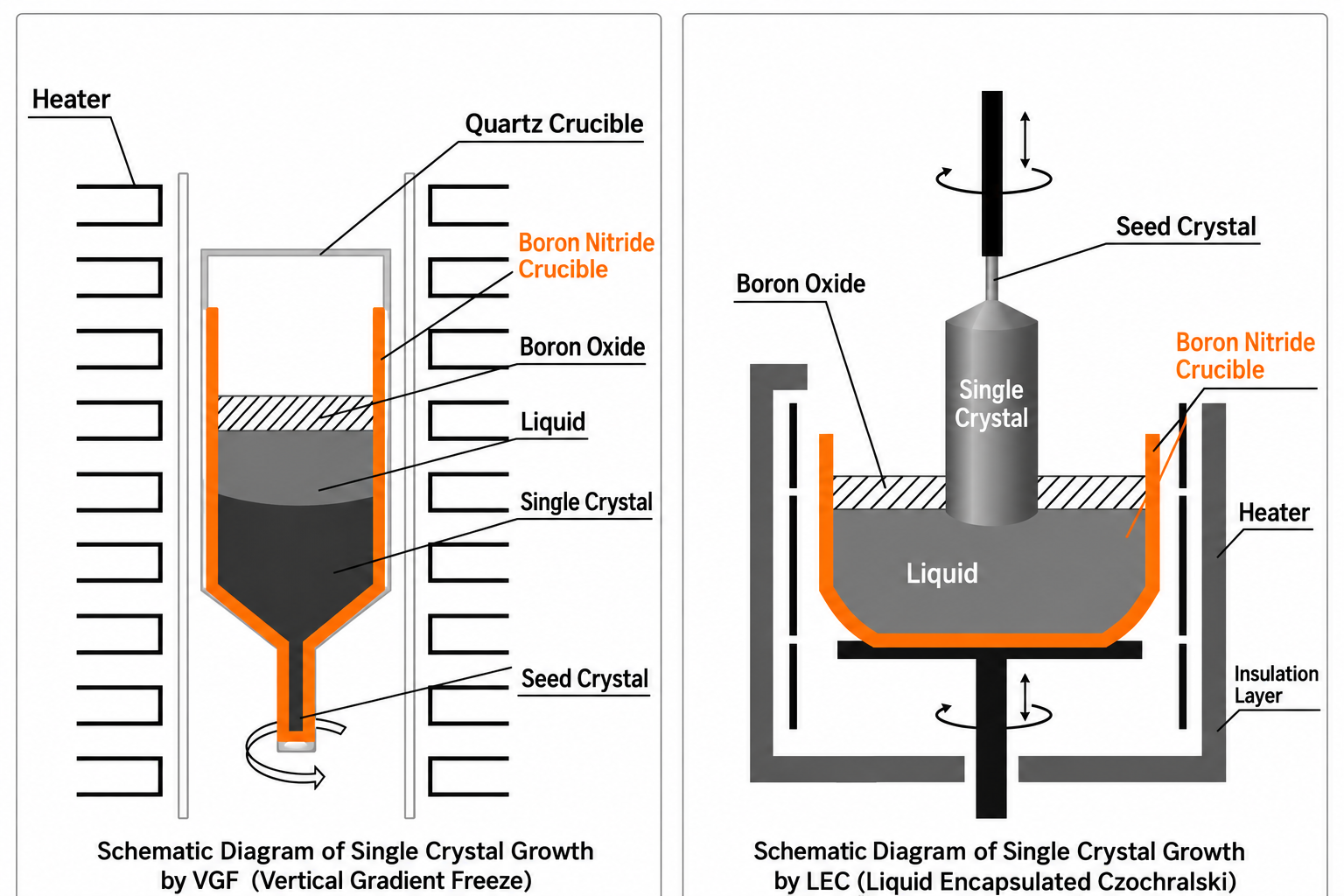
Vertical Gradient Freeze (VGF) and Liquid Encapsulated Czochralski (LEC) are two representative crystal growth methods used in the production of InP single crystals.
Although PBN crucibles can be used in both processes, the differences in crystal growth mechanisms lead to distinct considerations regarding crucible structural design, dimensions, and compatibility with the equipment’s thermal field.
VGF Crystal Growth: Crucible Design and Temperature Gradient Control
VGF (Vertical Gradient Freeze) is a crystal growth method that relies on controlled temperature gradients to achieve directional solidification.
In this process, the temperature field inside the furnace is carefully controlled, allowing the melt to gradually solidify under a defined temperature gradient and form a single crystal. Unlike crystal pulling methods, VGF crystal growth typically takes place within the crucible itself.
Therefore, the crucible serves not only as a container for the molten material but also as an important component whose geometry, wall thickness, and bottom structure must be compatible with the solidification process and the equipment’s thermal field.
For PBN crucibles used in VGF crystal growth, several key factors should be considered:
Different VGF systems and crystal growth processes may require different crucible configurations. Therefore, crucible selection and design should be based on actual process conditions and product drawings.
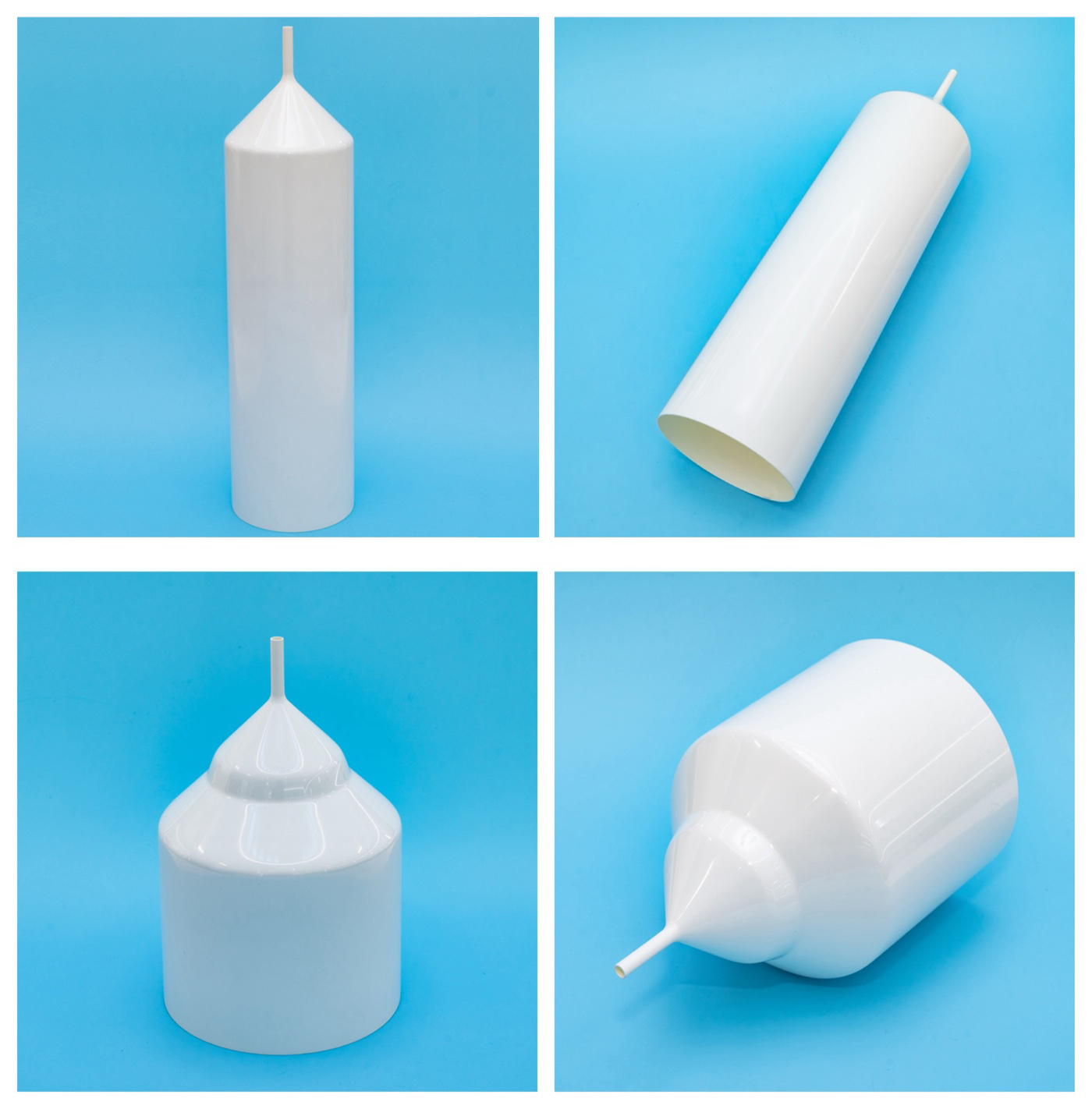
Glojin VGF PBN Crucible
LEC Crystal Growth: Liquid Encapsulation and Crystal Pulling Conditions
LEC (Liquid Encapsulated Czochralski) is a crystal growth method that uses a liquid encapsulant to protect the melt during single crystal growth.
In this process, the melt is covered with a liquid encapsulant, typically boron oxide (B₂O₃), while a seed crystal is pulled under controlled temperature and pressure conditions to achieve single crystal growth. Specific operating conditions depend on the material system and crystal growth equipment.
Unlike the VGF process, where the crystal gradually solidifies within the crucible, LEC crystal growth takes place through a controlled pulling process. The crucible primarily serves to contain the melt, accommodate the liquid encapsulation environment, and maintain compatibility with the equipment’s thermal field.
Therefore, several key factors should be considered when selecting PBN crucibles for LEC crystal growth:
The specific dimensions, structural configuration, and operating requirements of PBN crucibles should be determined based on the parameters of the LEC crystal growth equipment and the corresponding process specifications.
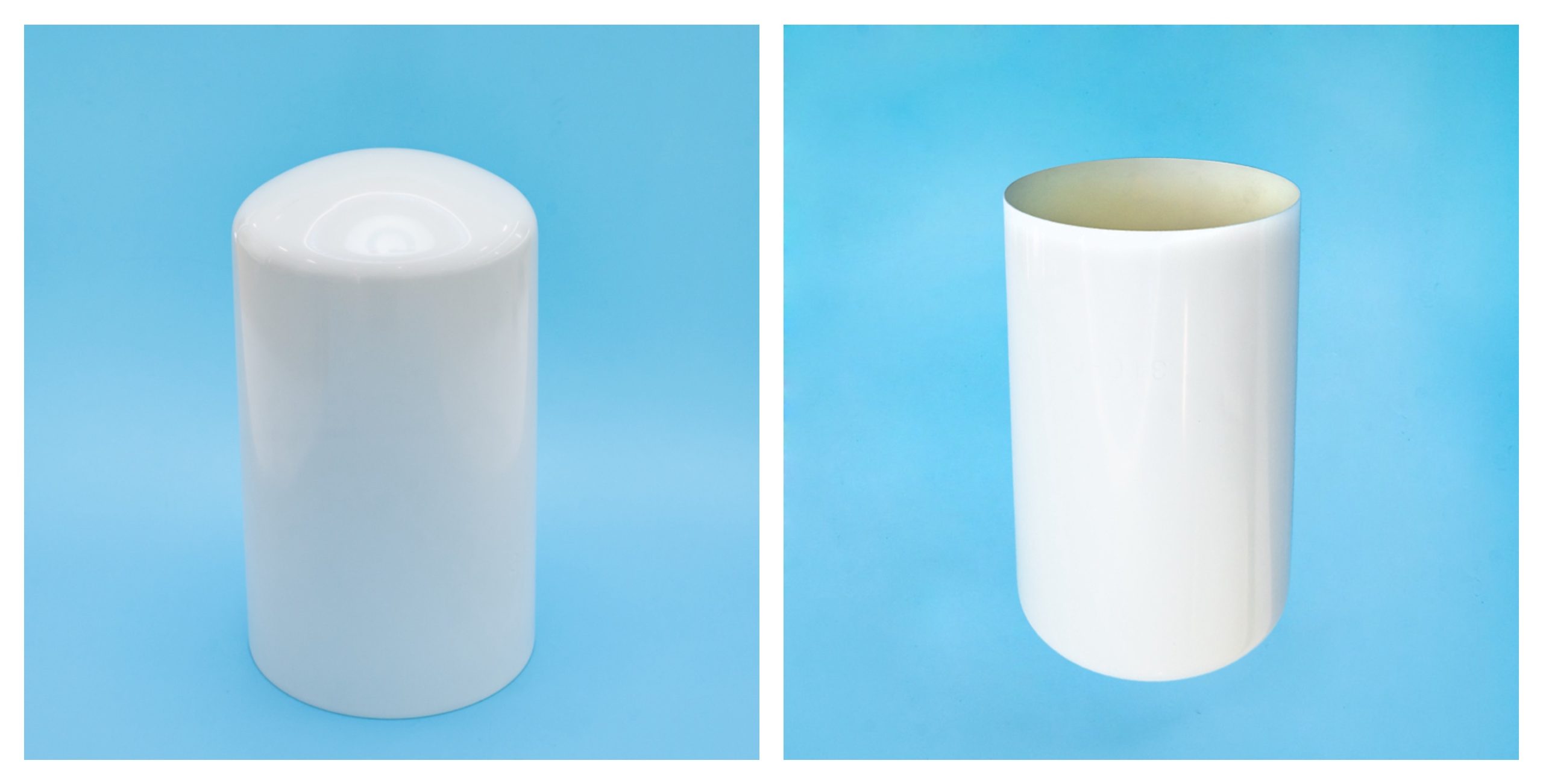
Glojin LEC PBN Crucible
| Comparison | VGF Process | LEC Process |
|---|---|---|
| Crystal Growth Method | Gradual solidification of the melt | Crystal growth through seed crystal pulling |
| Crucible Function | Contains the melt and supports the solidification process and thermal field requirements | Contains the melt and accommodates liquid encapsulation and crystal pulling conditions |
| Structural Considerations | Overall geometry, bottom structure, and wall thickness | Opening design, dimensions, and melt capacity |
| Key Compatibility Requirements | Temperature gradient, solidification conditions, and equipment dimensions | Liquid encapsulation environment, thermal field conditions, and crystal pulling equipment requirements |
Although PBN crucibles can be used in both VGF and LEC processes, their specific structural designs and operating requirements are not necessarily the same.
Crucible suitability must be determined by the actual equipment configuration, process conditions, and product specifications. Crucibles should not be considered interchangeable solely because they are made from the same material or have a similar appearance.
In practical purchasing and operation, selecting the right PBN crucible requires more than understanding its material properties. Product specifications must also be carefully evaluated against the requirements of the intended crystal growth process.
For compound semiconductor crystal growth applications, including indium phosphide (InP), four key factors should be considered.
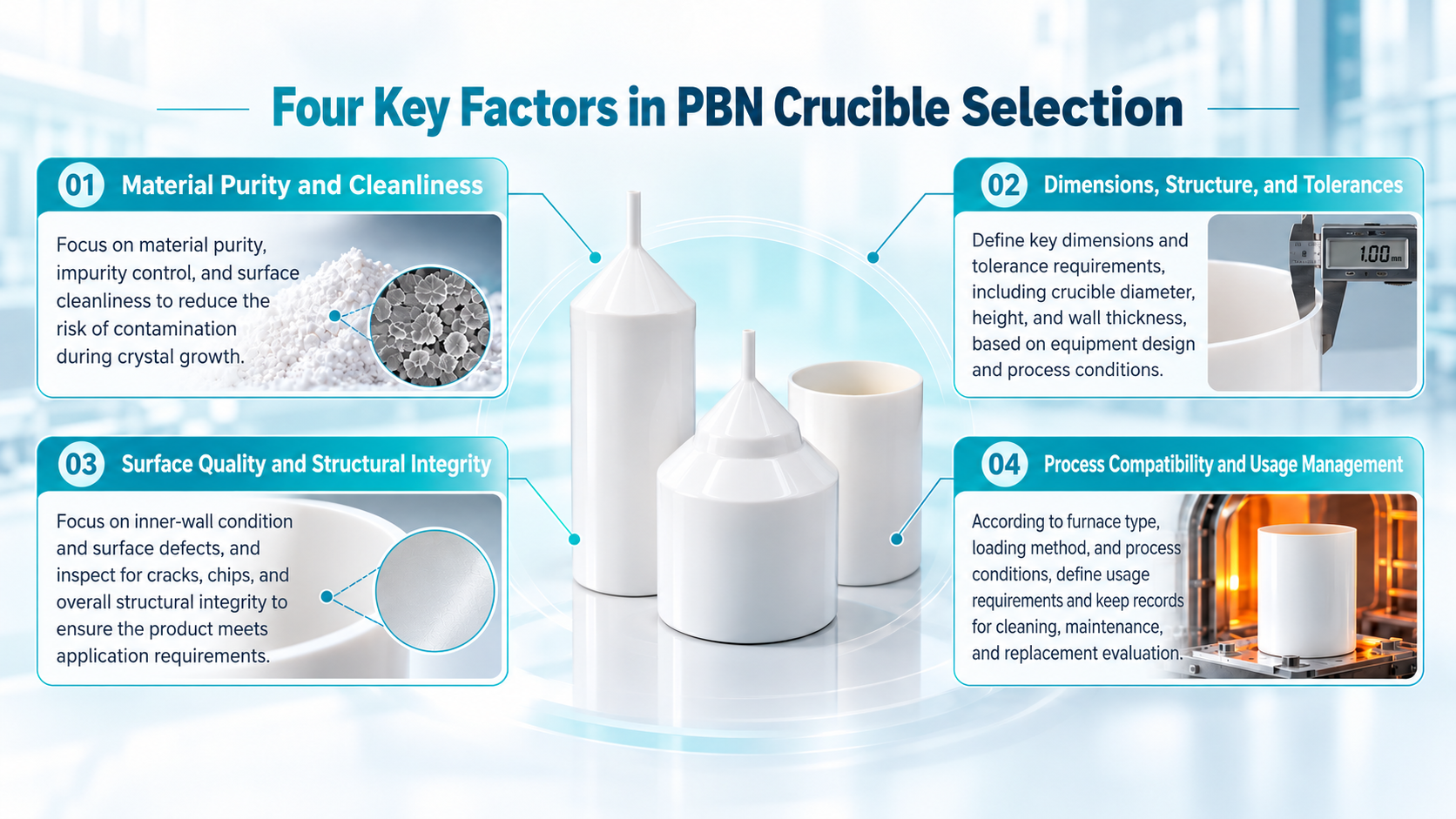
Depending on the crystal growth material and process requirements, particular attention should be paid to the material purity, impurity control, and surface cleanliness of PBN crucibles.
Especially in applications where the crucible comes into direct contact with the melt, surface residues and pre-use cleaning conditions are important considerations for product inspection, acceptance, and operational management.
The diameter, height, wall thickness, and critical structural dimensions of the crucible must be compatible with the crystal growth equipment and specific process requirements.
Dimensional tolerances and structural specifications may vary depending on the equipment. Therefore, these requirements should be verified against technical drawings and relevant specifications.
The condition of the crucible’s inner surface, potential surface defects, and overall structural integrity are essential factors in product quality evaluation.
During product inspection and acceptance, attention should be paid to surface irregularities, cracks, chips, and other potential defects based on the applicable product specifications to ensure that the crucible meets the intended application requirements.
Crucible installation methods, heating conditions, and operating requirements may vary depending on furnace configurations and crystal growth conditions.
During operation, it is recommended to maintain records of crucible condition, cleaning procedures, and any observed abnormalities. These records can provide valuable references for future product selection and operational management.
Proper PBN crucible selection requires a comprehensive evaluation of material properties, structural design, quality requirements, and specific process conditions to ensure compatibility with the intended application.
Glojin Advanced Materials Co., Ltd. specializes in the research, development, and manufacturing of advanced ceramic materials. Leveraging its Chemical Vapor Deposition (CVD) technology, Glojin provides PBN crucibles for compound semiconductor crystal growth applications.
Currently, Glojin PBN crucibles are already used in both Vertical Gradient Freeze (VGF) and Liquid Encapsulated Czochralski (LEC) processes for indium phosphide (InP) crystal growth, supporting the structural configurations and process requirements of different crystal growth systems.
For various equipment configurations and operating conditions, Glojin focuses on key factors such as crucible material purity, dimensions, structural design, surface quality, and process compatibility.
During the product consultation process, customers can provide technical drawings and relevant specifications. For projects without complete drawings, Glojin can work with customers to clarify product types, dimensions, and structural requirements through preliminary technical discussions, then prepare corresponding drawings for customer review and confirmation.
By aligning crucible design with specific process requirements, Glojin provides tailored PBN crucible solutions for various crystal growth applications.
From VGF to LEC, different crystal growth methods place distinct requirements on crucible performance and design. Material purity, structural design, and process compatibility are all essential considerations when selecting suitable PBN crucibles.
Glojin Advanced Materials Co., Ltd. remains committed to advancing PBN material technology and manufacturing, addressing the practical needs of compound semiconductor crystal growth applications, and providing professional product support to customers worldwide.